
Bill Nicholson
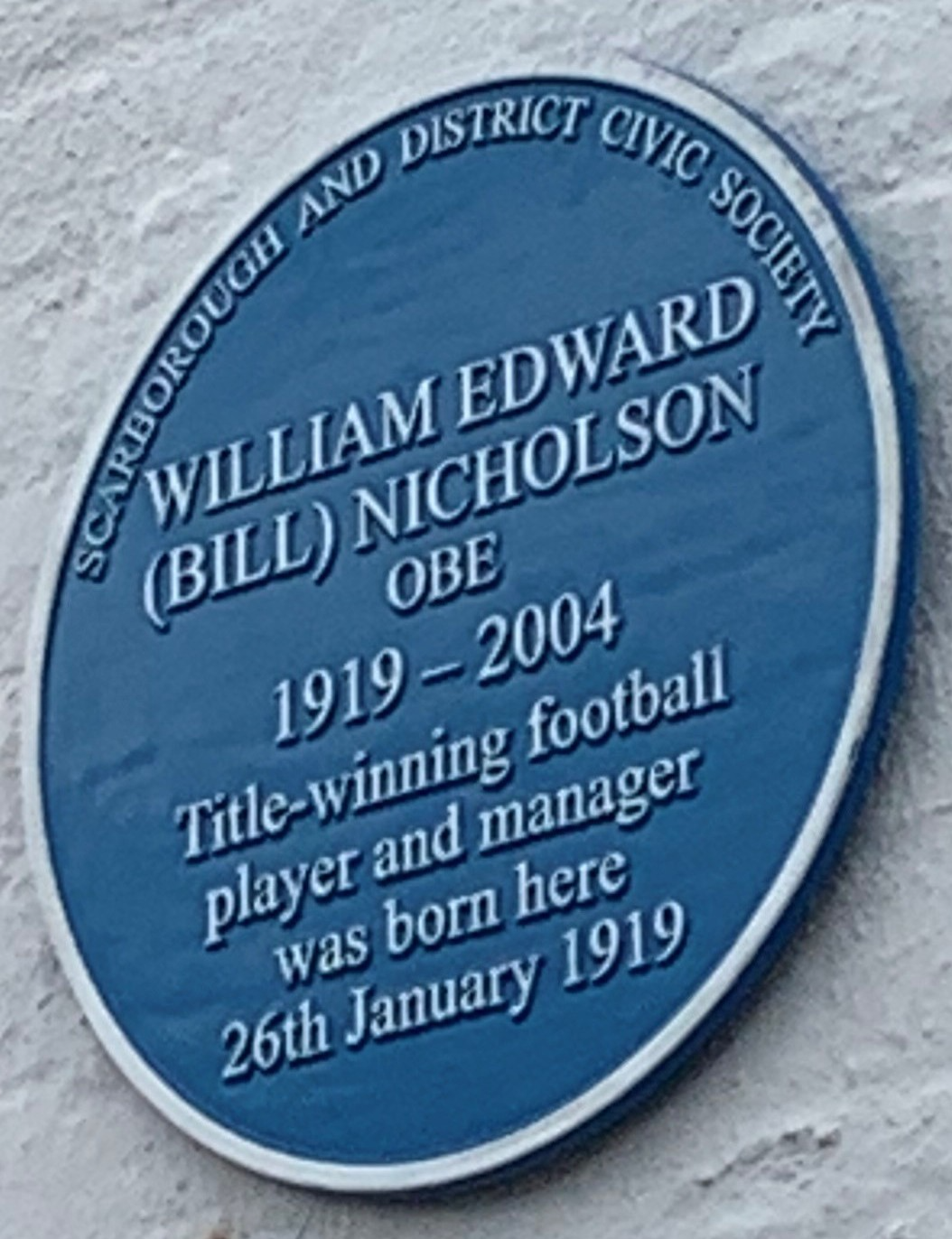
On July 1st 2026 we unveiled a plaque to commemorate the life of Bill Nicholson, the Tottenham Hotspur and England footballer. A Spurs supporter who bought a copy of the civic society publication, Blue Plaques in Scarborough , was surprised to find that Bill Nicholson did not feature there among notable figures such as Anne Bronte, Max Jaffa etc. So, we researched his connection with Scarborough. Bill was born on 26 th January 1919 here at 15 Vine Street. In the early 1900s it was a livery stable with dwelling accommodation attached. His father, Joseph worked as the driver of a horse-drawn landau. He used to give holiday makers rides along the sea front and take wealthy residents to church on Sundays. Bill used to love helping his dad caring for the horses. His mother, Edith had her work cut out looking after a large family. Bill was the eighth of nine children with four brothers and four sisters. Bill left school at 16 to work for a local laundry. However, in February 1936, he received a letter out of the blue inviting him for a trial at the north London club, probably on the recommendation of the manager of the Young Liberals local team he had been playing for on Saturdays. He was taken on as a ground staff boy at £2 per week and played his first professional match in 1938 aged 19. He only played eleven games before his career was interrupted by the Second World War, which saw him enlist with the Durham Light Infantry. He worked as an infantry training instructor and then in the Army Physical Training Corps, where he rose to the rank of sergeant. While home on leave in 1942, he married Grace, a machinist, from Tottenham. He returned to Spurs in 1946 aged 27 with possibly half his playing career over. With Bill playing at right-back, the club won the league championship for the first time in their history in the 1950-51 season. Bill only played for England once on 19 th May 1951, during the injury of Billy Wright who played in the same position. However, he scored after only 19 seconds with his first touch of the ball . Bill’s playing career came to an end in 1955, and he joined Spurs coaching staff. Skills gained from his service in the army put him in good stead for the role. He was later appointed assistant manager and Spurs asked him to take over as their manager in October 1958 at the age of 39. In the 1960-61 season Spurs completed the double, winning the league title for the second time and the FA Cup. Spurs won the FA Cup again in 1961-62. In 1963 Spurs had success in Europe, winning the Cup Winners Cup, beating Athletico Madrid 5-1. They won the FA Cup for a third time in seven years at the end of the 1966-67 season, won the league cup in 1971 and 1973, and a second European trophy (the UEFA Cup) in 1972 . Bill announced his retirement as manager in 1974. He did some scouting for West Ham, before returning to Spurs as a scout and consultant in 1976. He was appointed OBE in 1975, received the freedom of Haringey in 1998 and was inducted into the National Football Museum Hall of Fame in 2003. He was Spurs club president from 1991 until he died. Bill always remembered his Scarborough roots. Throughout his time as player and manager, he returned to the town every year to spend his summer holiday with his mother and sister Edith (his contract only allowed him two weeks annual leave). He lived in the same modest terraced house, within a ten-minute walk of the White Hart Lane ground throughout his playing and managing career. He named it Peasholm after the park in Scarborough.