



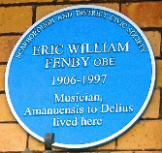
Eric Fenby
Born
in 1906, and educated at Scarborough Municipal School, Fenby was incredibly
musically gifted, endowed with perfect pitch and a fine treble voice. By the age of twelve, he was organist at Holy
Trinity Church. As a young man, he was
involved in accompanying singers at local choral societies. His talent was recognised by Alick Maclean,
conductor of the Scarborough Spa Orchestra, who invited him to conduct his
early compositions, and introduced him to some of the finest musicians from
other orchestras, playing during the orchestra’s summer season. In
1928, at the age of 22, Fenby heard that Frederick Delius, then living at Grez-sur-Loing
in France, was gravely ill with a condition which left him blind and virtually
paralysed. Delius had a wealth of
musical scores in his head, but no means of writing it them down. Fenby offered his services as amanuensis,
which Delius accepted beginning a six-year partnership until Delius died in
1934. This was a fraught period in
Fenby’s life because of Delius’s condition and cantankerous temperament;
however, Delius was able to complete several of his finest works, including A
Song of Summer and Songs of Farewell.
Towards the end, Fenby was effectively acting as nurse to the dying
composer, and after his death, assisted his severely ill widow, arranging for
his exhumed body to be returned to Limpsfield in Surrey for permanent burial. The
episode was recounted in Ken Russell’s 1968 film, A Song of Summer, with Fenby
as adviser on the script. Fenby featured
in a 1981 documentary film, A Song of Farewell, which followed him as he made a
return visit to Grez-sur-Loing. The film
was screened to a packed house at the Stephen Joseph Theatre. Fenby
worked as a consultant for Boosey & Hawkes, who published all the works
Delius had dictated to him, and assisted Sir Thomas Beecham in 1935 with the
production of Delius’ opera, Koanga, at Covent Garden. He
knew the Laughton family and in 1939 wrote the score for the film Jamica Inn,
starring Charles Laughton. His cinema career was ended by the Second World War,
in which he was commissioned in the Royal Army Education Corps. After
the war, he married Rowena, daughter of a Scarborough vicar, and they had two
children, Roger and Ruth. Fenby then
turned to teaching, being appointed Music Director of the then North Riding
College of Education (now Scarborough TEC) in 1948. The Civic Society will be unveiling a further
heritage plaque next year to celebrate this association. He
was later appointed Professor of Harmony at the Royal Academy of Music in
1964. He was awarded the OBE in 1962 for
his work as artistic director of the Delius Festival in Bradford that year, in
which capacity he succeeded Beecham. He
retired from the Royal Academy in 1977 and returned to Scarborough, where he
died in 1997. He is buried in Scalby churchyard with his wife Rowena. Click here for a video of the unveiling